




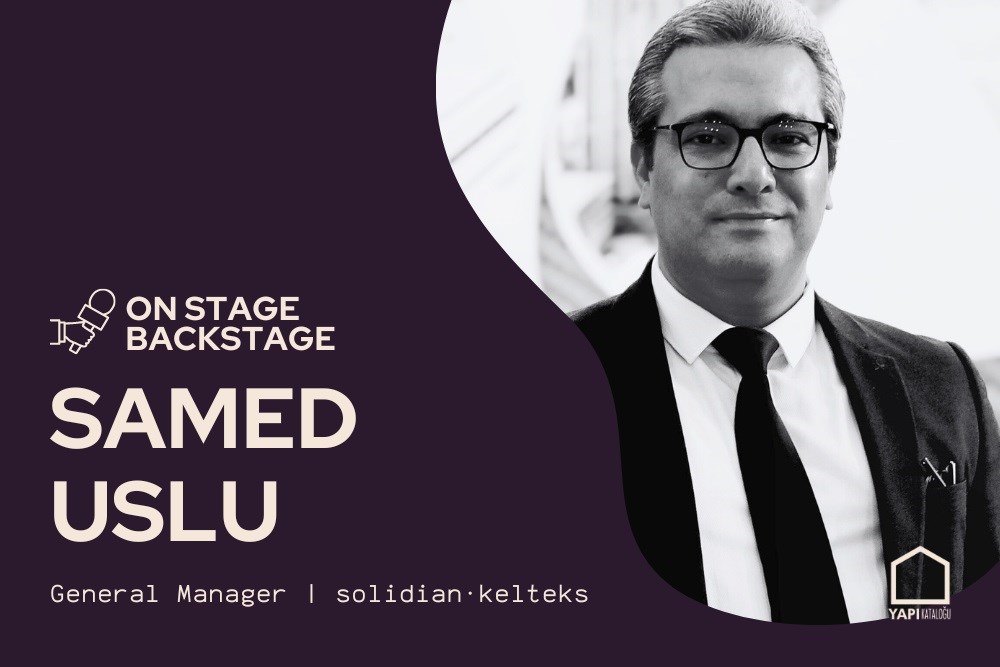
ON STAGE - BACKSTAGE with Samed Uslu
Our next guest in this series is Samed Uslu, the General Manager of solidian·kelteks in Türkiye. In our conversation, we discussed not only their business strategies and brand vision but also Samed Uslu's personal interests and inspirations. Get ready for an insightful look into Samed Uslu's world, both behind the scenes and in the spotlight!
ON STAGE
First of all, could you briefly tell us about yourself and your company's story?
I’m Samed Uslu. I am essentially a supply chain, trade and management professional and I have been working in the composite industry for about 10 years. For the past 3 years, I have been serving as the General Manager of solidian·kelteks Türkiye.
As solidian·kelteks, we have been developing and manufacturing high-tech technical textiles and reinforcements for the composite, construction and anti-seismic industries since 1990. We are an EU-based manufacturer. With our glass, carbon and basalt-based technical textiles and reinforcement systems, we aim to transform the traditional understanding of the industry and build the future together. For us, production is not merely an output; it is the tangible embodiment of a future vision blended with engineering, innovation and responsibility.
What sets your company apart in the industry?
What sets us apart in the industry is not just the products we offer, but also the mindset and solution philosophy behind those products. We view reinforcement not as a secondary accessory in a structure, but as a “core” that directly influences the fate of the structure.
In Türkiye, the conventional approach to construction production, which relies on steel reinforcement, still prevails. We do not offer an alternative to this approach but a direct transformation. We build systems that are lighter, stronger and fully resistant to corrosion using glass, carbon and basalt-based fibers and we implement this transformation not only ourselves but also in collaboration with our business partners on-site. Our difference lies in transforming technical innovation not just into an intention, but into a reality that simplifies everyone's work, from the engineer designing the project to the field applicator and provides safer structures.
What kind of cooperation strategy do you follow with other companies in the industry?
Since the day we started producing and supplying materials to the Turkish market, we have based our business on the concept of “partnership.” That is why we never refer to our customers as ‘customers’; to us, they are all “partners.” We adopt the same approach toward our business partners. This is because we believe that cooperation is not only commercial, but also intellectual and technical.
We see collaboration not as the opposite of competition, but as its complement. We establish multifaceted relationships with trading companies, manufacturers, applicators and designers specializing in the composite and construction industries. Materials alone do not mean much; mutual knowledge sharing is essential to use them in the right place, with the right details and with the right logic.
In this regard, we create effective and long-term environments in many different formats, such as joint product development, demo applications, joint webinars and technical trainings. In fact, for us, every collaboration is a process of mutual learning and development.
What trends do you think will come to the fore in the construction industry in 2025 and beyond?
I am convinced that corrosion-resistant reinforcements, low-carbon production techniques and digital production (BIM + 3D printing) are no longer just the “future” but today's reality and will continue to evolve.
However, the integration of energy efficiency, building physics and smart control systems will redefine both architectural and civil engineering paradigms. Now, it is not just about structural strength; a building's environmental impact, energy consumption, sustainability and performance throughout its lifecycle have become primary criteria. I also believe we are moving toward an era where buildings will be considered “living systems” equipped with sensor technologies that can generate and analyze their own data. The industry's focus is shifting toward achieving more performance with less material, minimizing environmental impacts and creating human-centric, smart buildings.
What do you think about the importance of participating in events such as Construction Innovation Days for industry leaders?
These types of events transform the “monologue” environment in the industry to “dialogue.” It's not just about presentations; perspectives, methods, mistakes and lessons are shared. Solving industry problems at a table or through individual efforts is often not feasible. Real solutions emerge in platforms like these, where interdisciplinary thinking, experience sharing and on-the-ground data are openly discussed. Construction Innovation Days, in this sense, provide a valuable platform where the collective intelligence driving the industry forward is nurtured.
Additionally, meeting the new generation of professionals and hearing their perspectives excites me and serves as a unique source of motivation. These events offer not only opportunities for knowledge sharing but also for expanding your professional network, gaining a more holistic understanding of industry dynamics and co-creating the future.
BACKSTAGE
What was your main motivation for entering the industry?
When I first encountered the composite industry about 10 years ago, I realized how huge and yet undiscovered the potential in this field was. Perhaps my personal curiosity and desire to solve problems also contributed to this spark burning even faster. The construction industry and the use of composite materials in it have a tangible impact, unlike many other fields. The materials you develop, the details you design and the decisions you make will remain in people's lives for years to come and the reliable materials you incorporate into any structure today will enable you to travel in time to the future. For example, I believe that Sinan the Architect (Mimar Sinan) was a time traveler who managed to disrupt the traditions, transporting himself not only to his own era but also to centuries later. Even after approximately 450 years, we still marvel at the genius in his works and draw inspiration from them. Or take Santiago Calatrava as a splendid example from our time; he has likely already sent himself to the year 2500 while still alive.
When faced with a difficult decision, what core value or belief propelled you forward?
First and foremost, it is my priority that this decision must be ethical and strategic. Rather than focusing on short-term gains and even profits, gaining respect, trust and stability in the long term is much more valuable. And of course, difficult decisions can disrupt your personal comfort zone and that is normal; therefore, I believe that you must prioritize the values you represent as an individual and subsequently the company, team and ultimately the well-being of society that you represent.
What hobbies or interests outside of work excite you?
Every moment I spend in contact with nature makes me feel good, but not so much in summer; I would say I enjoy the silence, coolness and tranquility of winter more. Of course, I recommend spending time in nature to everyone, regardless of the season; nature's healing power should definitely not be underestimated.
Apart from that, I have recently started to return to my two old hobbies: chess and antique rugs. Chess reminds me of skills such as strategy, foresight and patience, which are also very useful in the business world; antique rugs, on the other hand, offer the opportunity to discover past cultures and craftsmanship through their patterns, colors and weaves. Each one nourishes a different area.
Which city or building do you like the most in terms of architecture? Why?
I can say without hesitation that Istanbul is the city that has influenced me the most in terms of architecture. Unfortunately, we damaged it a lot recently, but Istanbul, which I hope and pray will remain this way for hundreds of years to come, is not just a city, but also a history book written through architecture and engineering. It combines the wisdom of the East with the technology of the West and the tension between the classical and the contemporary. The fact that such a complex group of structures a city still stands and continues to exist as a living city, is an engineering miracle in itself.
If I were to give an example from Europe, it would be Florence. It is not only the city where the Renaissance was born, but also an open-air museum where proportion, symmetry and the sense of space created by the nobility of materials are masterfully combined. Or Porto, which has carved out a very special place for itself in the last 20 years, hosting buildings that blend the old and the new with great subtlety and skillfully establish the relationship between concrete, stone and light.
Finally, to understand future-oriented architecture and engineering, we can refer to examples such as Masdar City in Abu Dhabi, Hammarby Sjöstad in Stockholm or Forest City in Malaysia. Architecture becomes sustainable and livable when it shapes the future by considering not only technology but also nature, humanity, and ethics in equal measure.