




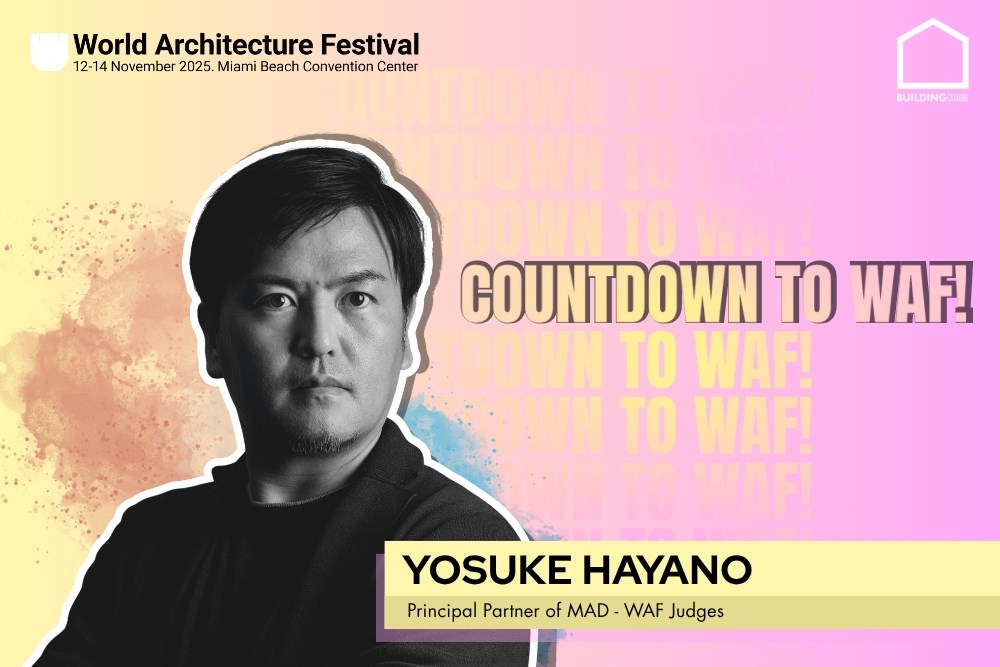
Countdown to WAF with Building Catalog | Interviews with Juries/ Speakers
One of the standout figures of the WAF 2025 jury is Yosuke Hayano. As a founding partner of MAD Architects, Hayano serves as a jury member at the festival. In an exclusive interview with Yapı Kataloğu, he shares his architectural vision and the design principles he values most.
Could you briefly introduce yourself?
I’m Yosuke Hayano, one of the Principal Partners at MAD Architects. Originally from Japan, I moved to London after completing my undergraduate studies to pursue a master’s degree at the Architectural Association School of Architecture. After graduation, I joined Zaha Hadid Architects, where I met Ma Yansong. A few years later, together with Ma and another partner, Dang Qun, we founded MAD Architects in Beijing, China.
What has been the most defining turning point in your architectural journey so far?
Designing the Tunnel of Light project in Echigo-Tsumari, Japan, has been one of the most defining moments in my architectural journey. Through this project, we explored how to blur the boundary between the artificial and the natural environment. It has since attracted many visitors and had a significant impact on the local community.
As an architect / an academic, what do you see as WAF’s greatest value—live presentations, its global perspective, or something else?
As architects, having our own vision and core values in design is crucial. However, architecture is also a social entity, and we must carefully observe society to understand its behavior. In this sense, seeing how other architects address similar or different social issues through their design methodologies is extremely valuable. I believe WAF provides a unique opportunity for this kind of exchange in our time.
What, in your view, makes a project truly unforgettable?
For example, every time I visit a Japanese or Chinese garden, I receive a different emotional response from the spatial experience. Depending on the weather, the season, or even my own psychological state, I perceive the sequence of spaces differently. I believe the same applies to architecture. A work of architecture that harmonizes with its surrounding environment and offers diverse perceptions to each visitor can become truly unforgettable.
How are today’s crises—climate, urbanization, migration—shaping tomorrow’s architecture?
The issues of climate change, urbanization, and migration are major challenges that architecture has never faced at this scale before. Today, we are witnessing how these forces are transforming our societies, and many of our cities are struggling to cope with such rapid change. I believe that in our time, we must redefine the meaning of the city and envision a new vision for the cities of the future — a task that must be pursued through collaboration across different disciplines.
Outside of architecture, which art form nourishes you the most?
Handcrafted wood carving is the art form that nourishes me the most. It involves the entire process — from imagination, material selection and sourcing, to processing and finishing — which is something architecture rarely allows in such a direct way. Using your own hands and body to realize what you imagine, without any external intermediaries, is a completely different and deeply personal creative process.
The one indispensable element in any project?
Vision
Where does your inspiration usually come from?
Travel
What is the most challenging aspect of architecture?
Being original
What makes a building timeless?
Relationship with enviornment
Which emotion do you value most in architecture?
Longing